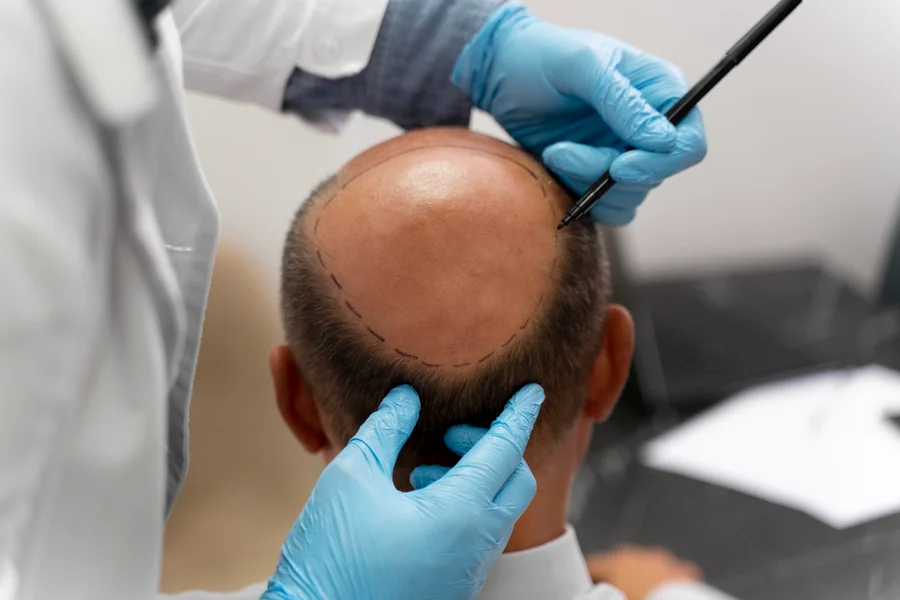
If you’re considering a hair transplant, chances are you’ve come across two popular techniques: Follicular Unit Extraction (FUE) and Follicular Unit Transplantation (FUT).
There is no right or wrong transplant technique. The suitability of a method depends on how much hair loss you have suffered, your hair restoration goals, and other personal preferences. Knowing the ins and outs of both FUE and FUT is the only way to make an informed decision. Let’s take a closer look!
What is Follicular Unit Extraction (FUE)
The Follicular Unit Extraction (FUE) is the more modern of the two methods. It involves extracting individual hair follicles from the donor area, which is generally the back and sides of your scalp. These tiny hair follicles are then transplanted into the balding and thinning areas of your scalp.
FUE is done by making tiny punches, typically 0.7-1.2 mm in diameter, at the donor site. Each follicular unit has 1-4 hairs. After the procedure, your scalp is bandaged for a few days. The initial hair usually falls out, and you can expect a fuller-looking head in about 12 months.
FUE Pros and Cons
The pros of FUE include:
- Minimally invasive
- No stitches requires
- Quick donor site healing compared to FUT
- Less scarring and faster recovery
The cons of FUE include:
- More expensive than FUT
- Lower yield of hair
- More time-consuming since individual hair follicles are extracted and transplanted
If you’re in Sydney, find the best hair transplant Sydney clinic that specialises in FUE to ensure natural-looking results.
Understanding Follicular Unit Transplantation (FUT)
Follicular Unit Transplantation or Linear Strip Excision is a hair restoration procedure where a strip of hair-bearing scalp is removed from a donor site. The strip is generally removed from the back of your scalp, where the hair is resistant to dihydrotestosterone (DHT) — a hormone that causes pattern baldness.
The strip can also be split into smaller sections with a surgical tool for more precise transplantation. The incision made at the donor site is stitched.
FUT Pros and Cons
The pros of FUT include:
- Cheaper than FUE
- Effective for transplanting a large number of grafts in a single session
- Easter to perform and takes less time
The cons of FUT include:
- A single, linear scar is left at the donor site. However, this is covered by existing hair
- Longer recovery and healing time than FUE
- Discomfort, tightness, and swelling in the donor area
Which Technique Offers Better Results?
As hinted earlier, no technique is “better” than the other. The right technique depends on your hair growth goals and personal preferences. For instance, if you have extensive hair loss and want to cover a wide area, FUT is a better option as it can yield more grafts in a single session. However, if you want minimal scarring and less downtime, FUE is more suitable.
As for the success rate, both techniques have similar and high success rates with similar results. At the end, it all comes down to the surgeon’s skill and whether or not you followed the aftercare instructions.

- 7 Lawn Care Hacks Every Homeowner Needs - June 8, 2026
- Can I Get The Best Dosa In Indiranagar Delivered To My Office By 9 AM? - June 5, 2026
- How to Choose the Best AI Anime Generator: Your Ultimate Guide - May 22, 2026